Mandatory e-invoicing in Slovakia from 1 January 2027: what changes and how to prepare
From January 2027, Slovak VAT payers send invoices to other businesses as e-invoices over the Peppol network, and every business must be able to receive them. Who must do what, exemptions, deadlines, penalties and 5 steps to prepare.
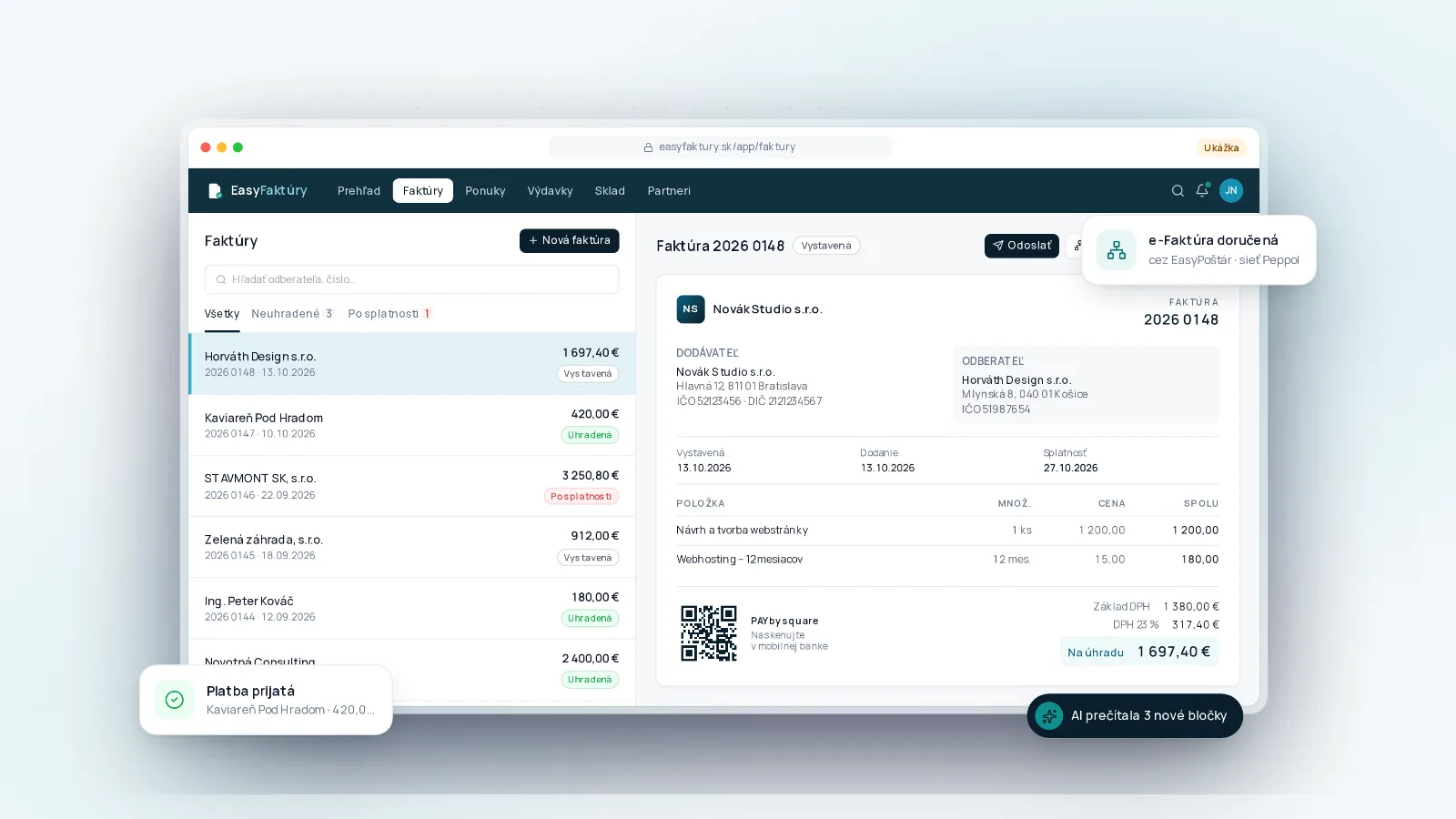
In ten weeks, the way Slovak businesses send each other invoices will change. From 1 January 2027, a PDF sent by email will no longer be a valid invoice for most business-to-business sales. The invoice becomes a structured file that travels over the European Peppol network – and its data also reaches the Slovak Financial Administration. This affects even businesses that don’t have to issue e-invoices themselves: everyone must be able to receive them.
What exactly applies from 1 January 2027
Act No. 385/2025 Coll. amended the Slovak VAT Act and introduced mandatory e-invoicing for a transitional period from 1 January 2027 to 30 June 2030. According to methodological guidance 1/DPH/2026/I of the Slovak Financial Directorate:
- Who issues: a domestic VAT payer supplying goods or services with the place of supply in Slovakia.
- To whom: another taxable person with its seat, place of business or establishment in Slovakia – including sole traders and businesses that are not VAT-registered – or a domestic non-taxable legal person. Both supplier and customer must be domestic.
- In what format: an electronic document structured according to the European standard EN 16931 that can be processed automatically. In practice, an XML file following Peppol BIS Billing 3.0. A PDF or an image of an invoice does not qualify.
- How it is delivered: through a delivery service run by a certified provider on the Peppol network. An e-invoice sent this way does not need the customer’s consent; sending it any other way requires it.
- Deadline: still 15 days from the supply of goods or services, or from receiving an advance payment.
The obligation also covers credit notes and corrections to e-invoices, and summary invoices for a calendar month.
What is exempt
- Supplies exempt from VAT under Sections 28 to 43 and Section 47 of the VAT Act.
- Simplified invoices – a receipt of up to €100 including VAT, or a receipt from an eKasa cash register.
- Sales to private individuals who are not in business (B2C).
- Invoices to and from foreign businesses – their turn comes in 2030.
Everyone must be able to receive
This is the part many people miss. Every domestic customer to whom a supplier must issue an e-invoice has to make sure they can receive it through a delivery service. The Financial Administration puts it plainly: receiving electronic invoices will be mandatory for all legal persons and entrepreneurs – including sole traders, the self-employed professions, independent farmers and property landlords. A business that is not VAT-registered does not have to issue e-invoices in the transitional period, but it does have to receive them.
Reporting data to the tax authority and penalties
E-invoicing comes with a reporting obligation. A VAT-registered supplier fulfils it simply by handing the e-invoice to the delivery service; the provider passes the data on to the Financial Directorate. A VAT-registered customer must report the data from a received e-invoice within five days of receiving it, also through the delivery service.
For failing to report, reporting late, or reporting incomplete or incorrect data, the tax office can impose a fine of up to €10,000, and up to €100,000 for repeated breaches. It will not impose one, for example, for an obvious mistake that the payer corrects, or for a proven technical failure on the delivery provider’s side.
What comes in 2030
From 1 July 2030, e-invoicing extends to cross-border trade within the EU, and Slovakia introduces full electronic reporting. The VAT control statement and the EC sales list will be abolished. This follows the EU’s ViDA package (VAT in the Digital Age), adopted by the Council on 11 March 2025. Businesses that set up e-invoicing now will have most of the work behind them by 2030.
Overview: who needs to do what from 1 January 2027
| Situation | What applies |
|---|---|
| A VAT payer invoices a Slovak business or sole trader | e-invoice over Peppol within 15 days |
| A business that is not VAT-registered (e.g. a sole trader) | must receive e-invoices, does not have to issue them yet |
| Invoice to a private individual (B2C) | no change |
| Receipt up to €100 incl. VAT or from eKasa | no e-invoice obligation |
| VAT-exempt supplies (Sections 28–43, 47) | no e-invoice obligation |
| Invoice to or from abroad | no change until 30 June 2030 |
| A VAT payer received an e-invoice | report the data within 5 days |
The table is a simplification – check the exact scope of your obligations with your accountant or on the Financial Administration website.
How to prepare: 5 steps
- Find out where you stand. Are you VAT-registered? Do you invoice Slovak businesses and sole traders, or mostly private individuals and foreign customers? That tells you whether you will only receive e-invoices or issue them too.
- Choose a delivery service provider. The easiest way is an invoicing tool with a built-in delivery service. You confirm the provider and the authorisation in an app on the Financial Administration portal.
- Clean up your customer data. On the Peppol network, Slovak businesses are addressed by their tax ID (DIČ). Missing tax or VAT IDs and outdated addresses in your customer list will be the reason an e-invoice doesn’t go out in January.
- Set up receiving. Who will check incoming e-invoices, how will they reach your accountant, and how will you meet the five-day reporting deadline? Agree on it with your accountant while it’s still 2026.
- Try it in advance. Voluntary adoption has been possible since the second quarter of 2026. It’s better to send your first e-invoice in November than on 2 January.
The good news: an e-invoice arrives as data, not as an image. Re-typing and extracting data from PDFs of Slovak suppliers goes away. As we wrote in our article on AI invoice processing automation, receipts, invoices from non-VAT-registered suppliers and invoices from abroad will keep arriving as PDFs and scans – so it pays to use a solution that handles both.
How we handle it in EasyFaktúry
For mandatory e-invoicing, we at Easytrade built our own invoicing system, EasyFaktúry. You send a finished invoice as an e-invoice in one click, and the EasyPoštár service takes care of delivery over the Peppol network. Received e-invoices show up as expenses ready for review, an invoice with a payment QR code takes 30 seconds, and AI reads the receipts and documents that don’t arrive as e-invoices.
You can receive e-invoices in EasyFaktúry for free, with no time limit. Paid plans come with a 14-day free trial, no credit card required. All our solutions are listed on the products page.
Key takeaway: From 1 January 2027, Slovak VAT payers issue invoices to domestic businesses and sole traders as EN 16931 e-invoices over the Peppol network, and every entrepreneur – VAT-registered or not – must be able to receive them. B2C sales, receipts up to €100 and from eKasa, exempt supplies and foreign trade are excluded. VAT payers report the data from a received e-invoice within five days, or face a fine of up to €10,000. Choose a delivery service provider, clean up your customer data and send your first e-invoice while it’s still 2026.
Not sure how to connect e-invoicing to your ERP or accounting system, or want to automate receiving e-invoices straight away? Start with a free consultation – we’ll help you get ready before January.
Sources
- Slovak Financial Administration – e-invoice (effective from 1 January 2027, mandatory receiving for all legal persons and entrepreneurs, Peppol BIS format based on EN 16931, certified delivery service providers, voluntary adoption from Q2 2026; in Slovak) – https://www.financnasprava.sk/sk/podnikatelia/dane/dan-z-pridanej-hodnoty/e-faktura
- Slovak Financial Directorate – Guidance 1/DPH/2026/I on Act No. 385/2025 Coll. (scope in the transitional period 1 January 2027 – 30 June 2030, exemptions, 15-day deadline, five-day reporting, fines of up to €10,000 and €100,000, abolition of the control statement from 1 July 2030; in Slovak) – https://www.financnasprava.sk/_img/pfsedit/Dokumenty_PFS/Zverejnovanie_dok/Dane/Novinky_leg/Nepriame_dane/2026/2026.01.14_001_DPH_2026_I.pdf
- European Commission – VAT in the Digital Age (ViDA): adopted 11 March 2025, digital reporting from 1 July 2030 – https://taxation-customs.ec.europa.eu/taxation/vat/vat-digital-age-vida_en
- OpenPeppol – Peppol BIS Billing 3.0 (EN 16931 model in UBL syntax) – https://docs.peppol.eu/poacc/billing/3.0/

A software and AI company from Košice, Slovakia – since 2011 we have helped companies integrate AI agents, automate processes and build custom software.